
Private flight Miami Opa Locka Executive air-charter
Private flight Miami Opa Locka Executive air-charter means OPF, the field north of the Miami city line. OPF has an 8,002 ft longest runway and four FBOs on the field. This page covers runways, ramp choices, summer heat and how we quote the route.
- KOPF · OPFfield codes
- 8 ftfield height
- 8,002 ftlongest strip
- 0 mito New York
A private flight Miami Opa Locka Executive air-charter begins with one practical question: which side of the field your aircraft parks on. The airport is in Opa-locka, a short drive from Hialeah, North Miami and the western suburbs, and road access runs off the Palmetto Expressway and I-95. Airport elevation is just 8 ft, so the air is dense here year-round and takeoff performance is rarely the constraint that mountain airports impose. With a longest runway of 8,002 ft at 8 ft elevation, most midsize and super-midsize jets leave Florida with full tanks and still climb comfortably. What changes from month to month is the ramp, the weather and how far ahead the aircraft has to be staged.
Runway length rarely decides whether a jet can serve a city pair from this field. It decides whether a heavy long-range aircraft can depart with full fuel on a hot afternoon, and whether a light jet has margin for a short hop to the Bahamas or the Gulf Coast. The density altitude figures below tell you more about summer departures than the runway number alone. Longer legs to the West Coast still need a fuel stop or a larger cabin, even from an 8,002 ft runway at sea level elevation. We size the aircraft to the leg rather than selling the biggest cabin on the ramp.
Most travelers using this field are heading to or from the Miami metro: business in Brickell or Coral Gables, a sailing weekend off Dinner Key, a family trip to the Keys, or an international connection that avoids Miami International entirely. The airport also draws traffic from Broward and Palm Beach residents who prefer the smaller footprint and quicker road access off the expressway. Arriving and departing from Opa Locka keeps the Miami Skyline close while avoiding commercial terminal congestion. Quote both your arrival and departure windows when you write, because ground handling demand here clusters around winter weekends and major Miami events.
Ground access and timing
Ground access runs off the Palmetto Expressway and I-95, which puts Opa-locka within a reasonable drive of Hialeah, North Miami and the western suburbs, and a longer but workable run from South Beach. Allow extra road time on winter weekends when Miami events, cruise turnarounds and holiday traffic stack up. If your itinerary crosses a border, plan for CBP clearance and confirm the ramp handles it on your arrival day, since not every international leg has the same inspection timing. Domestic legs are simpler: your car meets the aircraft and the party boards after the crew finishes loading.
Private jet routes via Miami-Opa Locka
The 6 private jet city pairs here span 199 to 2,129 nautical miles, with one-way light jet quotes running $4,000 to $36,000.
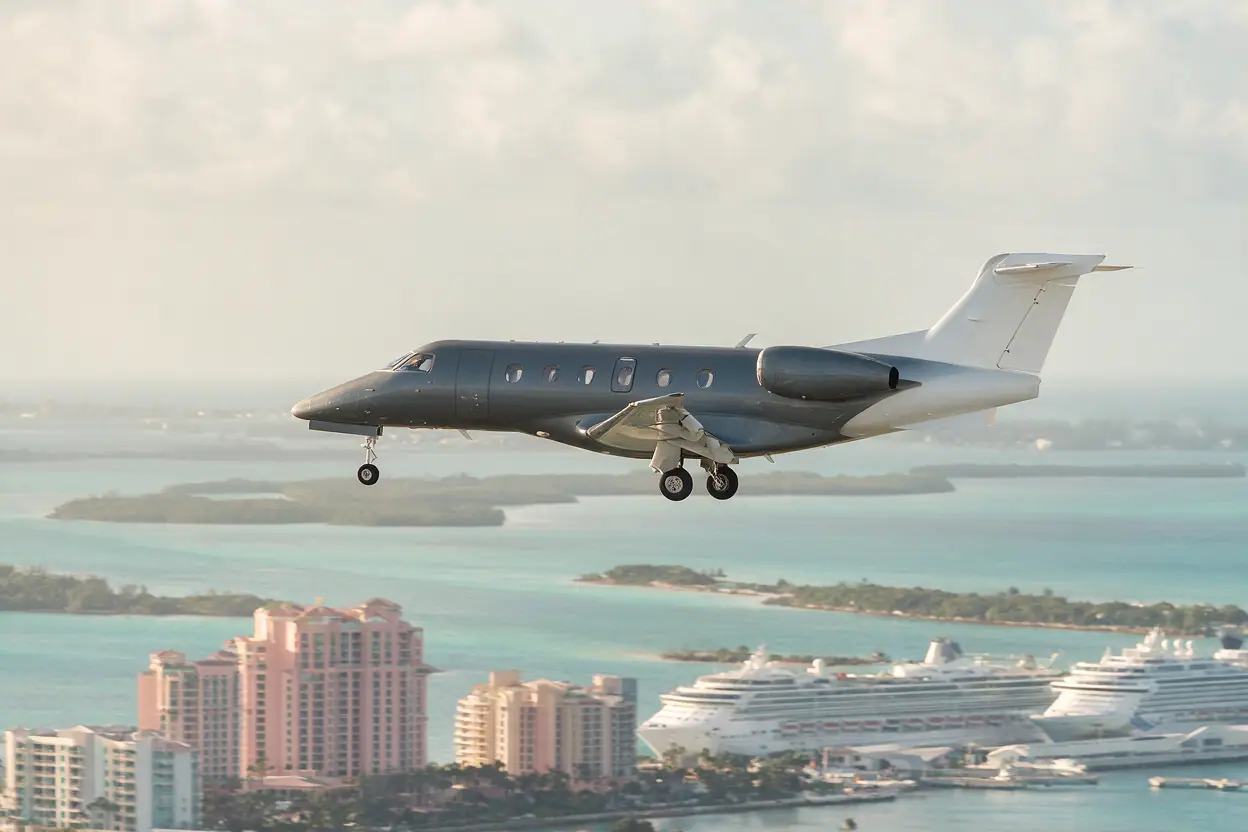



Runways and field data at Opa Locka
Opa Locka Executive has a longest runway of 8,002 ft, field elevation of 8 ft, and the ICAO code KOPF, short for the local code OPF and IATA code OPF. The 8 ft elevation is the lowest number that matters here, and it works in your favor. The 8,002 ft longest runway at 8 ft elevation supports most midsize jets on Florida and Caribbean legs. Runway selection on the day depends on wind and traffic flow, and pilots plan fuel around the departure runway the tower assigns rather than the longest one on paper. Ask us about your specific aircraft type if you are flying a heavy long-range cabin, since summer heat and fuel load together shape the takeoff plan.
| Rwy | Length | Width | Pavement |
|---|---|---|---|
| 09L/27R | 8,002 ft | 150 ft | Asphalt |
| 12/30 | 6,800 ft | 150 ft | Asphalt |
| 09R/27L | 4,309 ft | 100 ft | Asphalt |
Weather and density altitude by season
Summer afternoons matter most here: July and August average highs around 88 F push density altitude to roughly 1,900 ft, and the airport's hottest month plus an 8 F margin puts peak density altitude at about 2,500 ft. Those numbers are low compared with high-desert fields, but they still affect light jets on short runways and any aircraft loaded near maximum takeoff weight. From June through September, density altitude near 1,900 ft trims light-jet payload on short Caribbean hops from OPF. May through October also brings the wet season, with rain days peaking at 26 in August, so afternoon buildups can delay departure or push a crew to file a different routing. Winter is the busy stretch: January highs around 75 F, nine wet days and density altitude near 1,100 ft, which is close to optimal for performance.
| Mo. | Typical high | Days with rain | Density alt |
|---|---|---|---|
| Jan | 75°F | 9 | 1,100 ft |
| Feb | 78°F | 11 | 1,300 ft |
| Mar | 81°F | 9 | 1,500 ft |
| Apr | 84°F | 11 | 1,700 ft |
| May | 86°F | 17 | 1,800 ft |
| Jun | 87°F | 25 | 1,900 ft |
| Jul | 88°F | 24 | 1,900 ft |
| Aug | 88°F | 26 | 1,900 ft |
| Sep | 87°F | 24 | 1,900 ft |
| Oct | 84°F | 18 | 1,700 ft |
| Nov | 80°F | 12 | 1,400 ft |
| Dec | 77°F | 11 | 1,200 ft |
FBOs on the field
Four FBOs serve the field: Atlantic Aviation, Signature Aviation, Jet Aviation and Fontainebleau Aviation. The local code OPF appears on every itinerary, so confirm with your crew which ramp you are using before you send a car. With four FBOs, OPF passengers can usually find a ramp closer to the terminal they are using, so ask before you commit. Each handles its own ground transportation, catering and customs coordination for international departures. If your party splits across two aircraft, book both onto the same ramp to keep the ground transfer simple.
What this airport is best for
- Miami metro business trips where a car meets you at a smaller ramp instead of a commercial terminal curb
- Bahamas and Caribbean legs where a low-elevation field and an 8,002 ft runway keep fuel and payload flexible
- Keys and Gulf Coast weekend runs flown in light and midsize jets with short notice changes
- Family and group departures that want to split across two aircraft and park both on the same ramp
| Aircraft | Typical runway need | Local |
|---|---|---|
| Turboprop | 3,300 ft+ | Will fit |
| Light jet | 4,000 ft+ | Will fit |
| Midsize jet | 5,000 ft+ | Will fit |
| Super-midsize jet | 5,200 ft+ | Will fit |
| Heavy jet | 5,600 ft+ | Will fit |
Questions about this airfield
What is the ICAO and IATA code for Miami Opa Locka Executive?
The ICAO code is KOPF and the IATA code is OPF; the local code OPF is the same three letters you see on crew paperwork. The field sits at 8 ft elevation. Confirm the code on your quote and itinerary so the crew stages the right aircraft and the car goes to the right ramp rather than another Miami-area field.
How long is the longest runway at Opa Locka Executive?
The longest runway is 8,002 ft, with field elevation of 8 ft. That combination supports most midsize and super-midsize jets on Florida, Caribbean and East Coast legs. Heavy long-range aircraft should be checked against fuel load and summer density altitude before departure, since payload may need trimming on the hottest afternoons of July and August.
Which FBOs serve private flight Miami Opa Locka Executive air-charter traffic?
Four: Atlantic Aviation, Signature Aviation, Jet Aviation and Fontainebleau Aviation. Each runs its own ramp, ground transportation and catering coordination. Tell us which side of Miami you are heading to and we will quote the ramp that shortens your drive rather than defaulting to the first one on the list. Confirm the ramp on your itinerary before you send a car.
Is Opa Locka a port of entry for international arrivals?
Yes, the field handles international arrivals with CBP clearance, which is why Bahamas and Caribbean legs work well here. Confirm the ramp can process your arrival on your travel date, especially on weekends and during holidays. If your party includes non-US citizens, share that when you request the quote so the clearance step is built into the schedule rather than added on arrival.
How does summer heat affect departures from Opa Locka?
July and August average highs near 88 F push density altitude to about 1,900 ft, and the airport's hottest-month peak reaches roughly 2,500 ft. That trims payload on light jets carrying full fuel on short hops. From June through September we check your aircraft type, fuel load and passenger count together, then adjust the plan rather than quoting a number the day cannot support.
When should I request a private flight quote for a Miami trip?
Send the request as soon as your dates firm up, particularly for December through April, when Florida demand peaks. Winter weekends and major Miami events tighten aircraft availability and ramp space. Quotes are estimates and can move with fuel and aircraft availability. If your plans change, tell us early so we can re-shop the route instead of leaving you with a stale number.