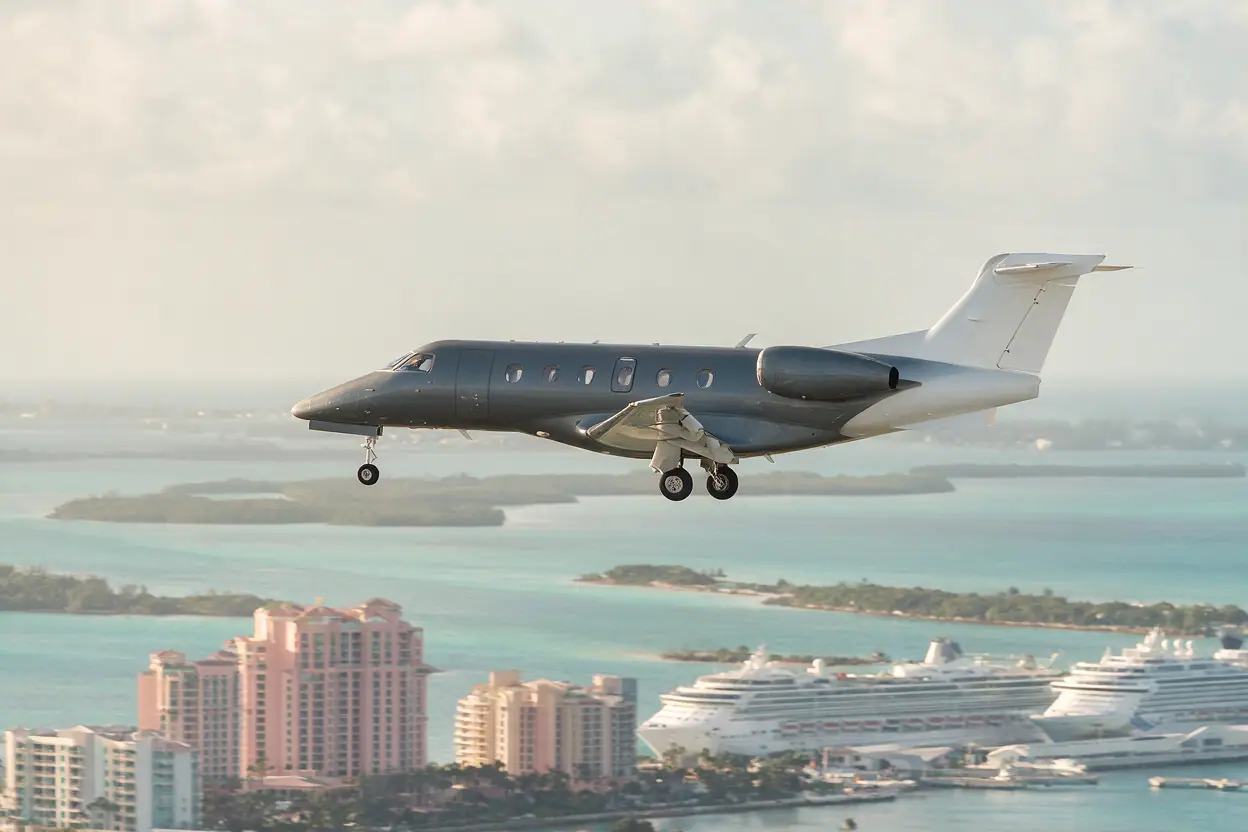
Private charter flight New York to Miami
A private charter flight New York to Miami covers 1,092 miles. Light jets make the nonstop trip in 2h 37m for roughly $10,000 to $15,000 one way. Those figures are estimates, so the booked quote moves with the date, the aircraft and the ground plan.
- 949 nm1,092 sm
- 2h 37mlight jet flight time
- $10,000–$15,000one-way quote
New York to Miami private jet costs by aircraft type
Flying private from New York to Miami is 949 nautical miles, about 2h 37m on a light jet, quoted near $10,000–$15,000 one way.The table below compares every class that can fly this route nonstop, with flight times and one-way price estimates. Times assume still air and typical routing, and prices are ranges rather than quotes. Use it to see where the jump between classes actually buys you something on a 949-nautical-mile leg, and where it mostly buys cabin height and luggage room.
| Class | Flight time | One-way ballpark | Notes |
|---|---|---|---|
| Turboprop | 3h 37m | $8,000–$12,500 | No fuel stop |
| Light jet | 2h 37m | $10,000–$15,000 | Best suited |
| Midsize jet | 2h 34m | $13,500–$20,000 | No fuel stop |
| Super-midsize jet | 2h 25m | $17,500–$24,000 | No fuel stop |
| Heavy jet | 2h 25m | $23,000–$35,000 | No fuel stop |
Ballpark figures are for the whole aircraft, not per passenger, and exclude federal excise tax and segment fees. Duration covers taxi, climb and descent.
Flying New York to Miami commercial or private
Airline figures are the cheapest fares Google Flights listed for a single traveller on Dec 9, 2026 (pulled Nov 15, 2026); the charter line is our estimate for the entire aircraft. With 7 passengers, airline first class seats come to roughly $2,548, versus $10,000–$15,000 to charter the entire light jet.
| Choice | Airline / aircraft | Hours | One-way ballpark | Seat share |
|---|---|---|---|---|
| Airline economy | Delta · nonstop | 3h 13m | $174 | $174 |
| Airline first class | Delta · nonstop | 3h 16m | $364 | $364 |
| Light jet | Entire aircraft, seats 7 | 2h 37m | $10,000–$15,000 | $1,430–$2,140 |
Airline ticket prices shift daily and do not cover bags above the fare allowance; the per-seat charter number presumes all seats are occupied.
When demand and prices peak
Winter is the busy season on this route, so December through March and holiday weeks are when aircraft are tightest and one-way estimates drift toward the top of the ranges. Winter weekends push light jet estimates toward the top of the range because so many travelers want the same Friday afternoon slot. When a boat show, a race weekend or a major event fills Miami, then the aircraft that would have flown back empty get booked instead, and return pricing gets firmer. That is the week to lock in the airframe rather than browse.
Midweek departures and quieter months price better, and the gap between a Tuesday and a Friday on the same leg can be wider than the gap between two classes. If your dates are flexible and you want the lower end of the light jet range, then aim for a midweek outbound and a return that is not on a Sunday or a holiday. Returning when a heavy jet is repositioning south can also be the moment a super-midsize quote drops. Book the return before you leave New York so the crew day is priced in.

Leaving the New York area
Check-in is basic: show up, and the crew boards you with no terminal walk and no security line. If you fly from Teterboro Airport, then plan for a little more road time than the map suggests, so the morning slot you booked is the slot you keep. The same runway handles everything from light jets to heavy jets, so ground flow at peak hours can affect your departure time more than the aircraft type.
Baggage rules depend on the airframe, not the class label. The Phenom 300E gives you 84 cubic feet and the PC-24 gives you 90, so if you are traveling with golf clubs or cases of equipment, tell the broker before the aircraft is fixed. When you are carrying more than a light jet's hold can take, then a super-midsize or heavy jet is the honest answer rather than a late change.
Arriving in Miami
The last hour of the flight is over water and the Florida coast, and you land into warm air most of the year. When the summer heat is at its worst, then the aircraft may need a slightly longer runway at the other end, which is one reason larger fields are worth knowing about. In practice the 8,002 feet at Miami-Opa Locka Executive Airport and the 13,016 feet at Miami International cover every class on this list with margin.
Ground transport from either airport into Miami Beach, Brickell or Coral Gables is straightforward, and the FBO ramp puts you in the car within minutes of the door opening. If your trip is tied to the Miami Grand Prix, Art Basel or a winter weekend, then allow for heavier road traffic and book the return leg before you leave New York. A private charter flight New York to Miami is a two-and-a-half-hour flight with a short drive at each end, so the day is genuinely workable.
| Field | ID | Rwy |
|---|---|---|
| Miami-Opa Locka Executive Airport | KOPF / OPF | 8,002 ft |
| Miami International Airport | KMIA / MIA | 13,016 ft |
| Teterboro Airport | KTEB / TEB | 6,997 ft |
| Westchester County Airport | KHPN / HPN | 6,549 ft |

How the light jet suits this route
A light jet is the sensible fit at this distance, and that is why it sits at the top of the table. Something like an Embraer Phenom 300E carries seven passengers at 464 knots with 2,010 nautical miles of range, so this route leaves a healthy reserve instead of a fuel stop, and a light jet that covers the 949 nautical miles nonstop with room for seven passengers does the job most travelers are actually paying for. The Pilatus PC-24 sits in the same class with eight seats and a taller cabin at 5 ft 1 in, which matters if you are working through the flight.
Midsize and super-midsize jets save minutes, not hours. The midsize figure is 2h 34m and the super-midsize figure is 2h 25m, so a super-midsize buys about twelve minutes over a light jet on this leg. A super-midsize jet saving roughly twelve minutes over a light jet is worth it when the cabin matters, not when the clock does. Heavy jets float between $23,000 and $35,000 one way and land at the same 2h 25m, so book one for the cabin, the range or the luggage, not the speed. A turboprop fits the distance but takes 3h 37m and asks $8,000 to $12,500, which is a fair trade only if price outweighs time.
Teterboro Airport is the default departure for most Manhattan and New Jersey travelers, with a 6,997-foot runway and a short ride across the Hudson. Teterboro Airport, with its 6,997-foot runway, keeps Manhattan travelers close to home and puts them in the air quickly once the car is away. Westchester County Airport, at 6,549 feet, serves the northern suburbs and Connecticut and often prices similarly. The home airport choice rarely changes the flight much at this distance, but it can change your morning.
On the Florida end, Miami-Opa Locka Executive Airport is the quiet general aviation field with an 8,002-foot runway, and most light and midsize jets use it. Miami International is the big commercial airport with a 13,016-foot runway, useful when schedules or ground plans point you there. Miami-Opa Locka Executive Airport and its 8,002-foot runway is the calmer arrival of the two, and the drive to Miami Beach or Brickell is short either way.
Embraer Phenom 300E
- 7 seats
- 464 kt cruise
- 2,010 nm max range
Cabin of 4 ft 11 in tall, 17 ft 2 in long. Luggage 84 cu ft.
Pilatus PC-24
- 8 seats
- 440 kt cruise
- 2,000 nm max range
Cabin of 5 ft 1 in tall, 23 ft long. Luggage 90 cu ft.
Other private jet routes like New York–Miami
The 6 private jet city pairs here span 808 to 1,042 nautical miles, with one-way light jet quotes running $8,500 to $16,500.

Queries on this lane
How long is a private charter flight New York to Miami?
Most nonstop legs run about 2h 37m on a light jet over the 949 nautical miles. A midsize jet makes it in 2h 34m, and super-midsize and heavy jets take 2h 25m. A turboprop takes 3h 37m. Add taxi time and a short drive at each end to get your door-to-door estimate.
What does a private jet from New York to Miami cost?
One-way estimates run from about $10,000 to $15,000 on a light jet, $13,500 to $20,000 on a midsize, and $17,500 to $24,000 on a super-midsize. Heavy jets range from $23,000 to $35,000. These are estimates, and the booked quote reflects the date, the aircraft and the return plan. Midweek dates usually land nearer the low end.
Which airports serve the Miami end?
Miami-Opa Locka Executive Airport has an 8,002-foot runway and handles most private flights, while Miami International has a 13,016-foot runway and suits larger aircraft and commercial connections. Both are short drives from Miami Beach, Brickell and Coral Gables. Let your ground plan decide which one you use.
Can I do a same-day round trip?
Often yes. With a 2h 37m light jet leg each way, a morning out and an evening back is realistic. Same-day returns usually mean paying for the aircraft to wait or for a crew day, so the return quote can exceed the outbound figure. Ask for the return as part of the first request so both legs are priced together.
How many passengers fit on a light jet for this route?
The Phenom 300E seats seven and the Pilatus PC-24 seats eight, both within the 2,000-nautical-mile range needed here. Baggage capacity of 84 to 90 cubic feet covers typical weekend and business loads. For a larger group, move to a super-midsize or heavy jet rather than stretching a light jet.
Which New York airport should I leave from?
Teterboro Airport has a 6,997-foot runway and suits Manhattan and New Jersey departures, while Westchester County Airport at 6,549 feet serves the northern suburbs and Connecticut. Both handle every class on this route. Compare the drive time against the schedule you actually want before deciding, because the road can decide your morning.