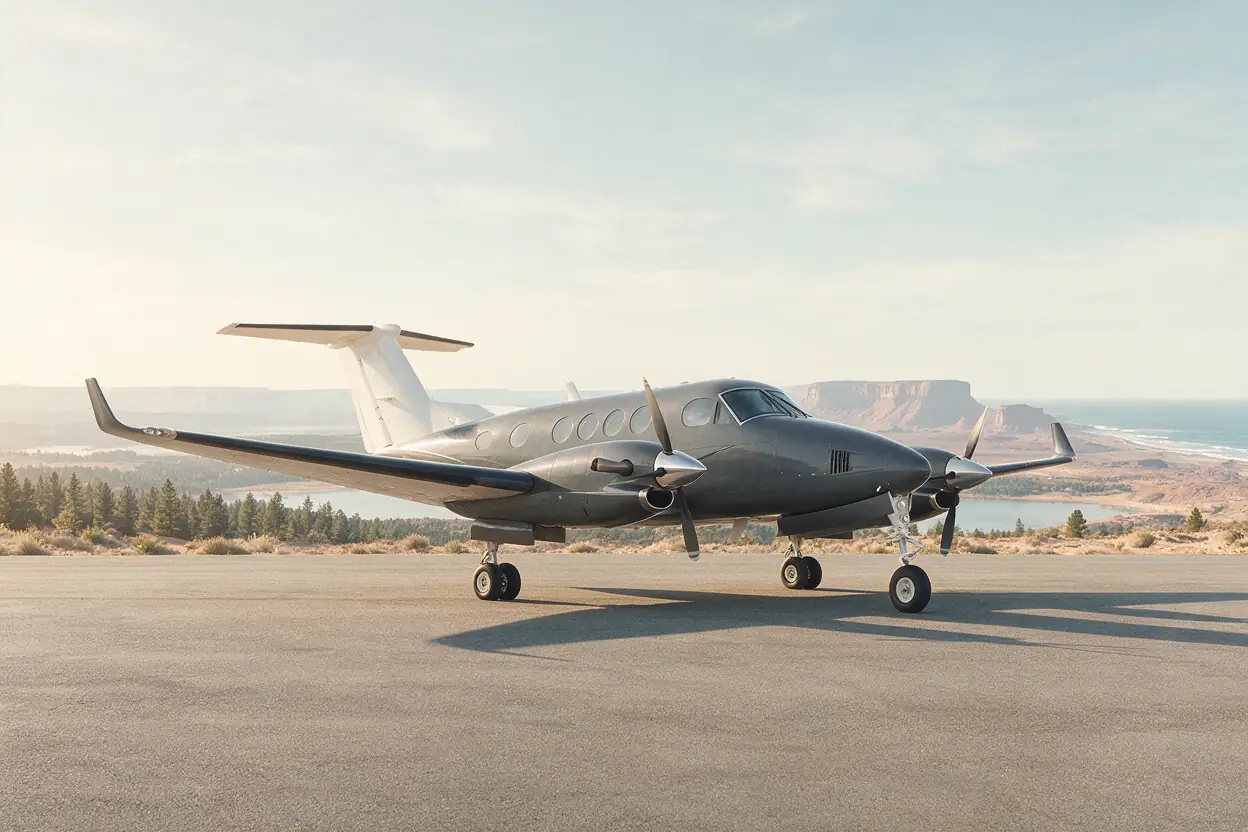
Turboprop charter flights
Turboprop charter flights balance cost, speed and runway access. Hourly rates run $2,200 to $3,500, with a cruise near 300 knots and 6 to 8 seats. The trade-off is time: slower than a jet, cheaper to run, and able to use shorter fields.
- $2,200–$3,500per flight hour
- 6-8seats filled
- 1,500 nmnormal range
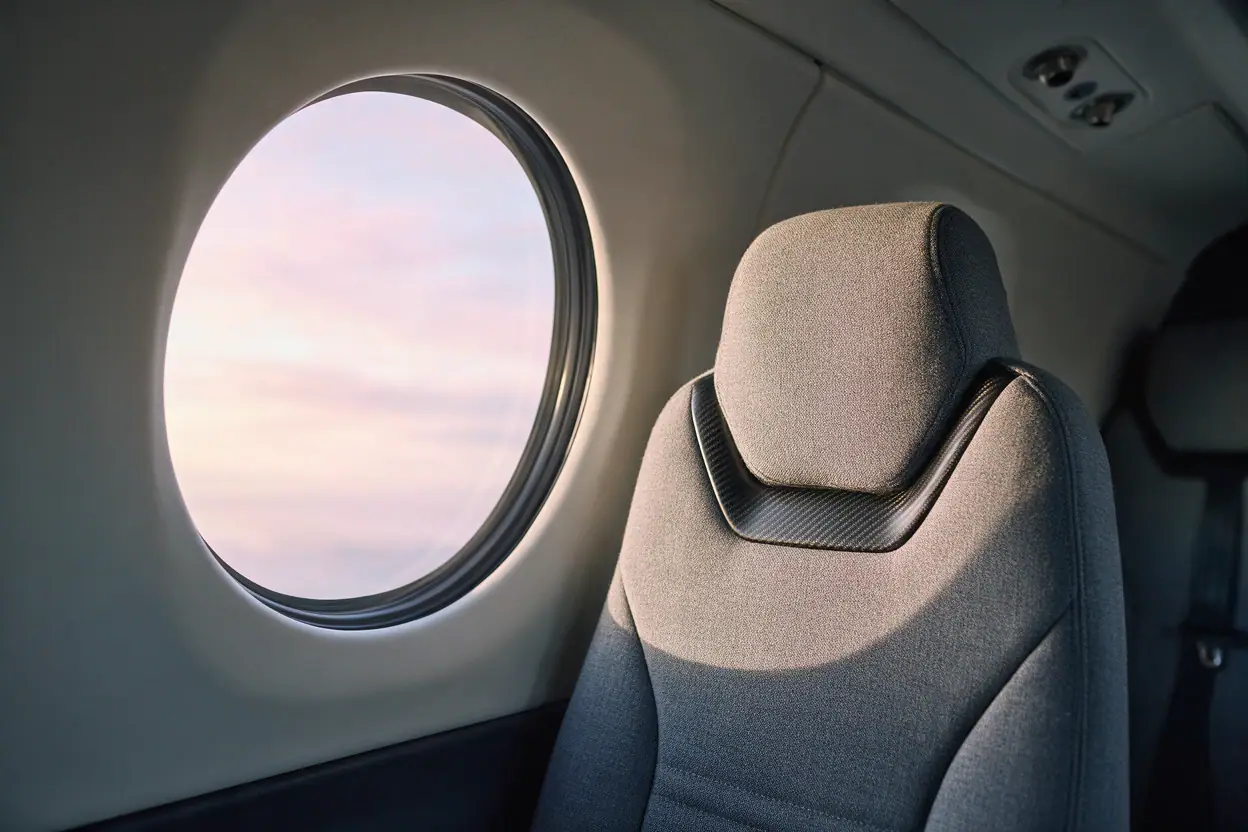
Turboprop charter flights cover a wide spread of capability, from the 6-seat Daher TBM 960 to the 8-seat Beechcraft King Air 350i. The TBM cruises at 330 knots with a 32 cu ft baggage hold, while the King Air carries 55 cu ft at 312 knots. Typical range reaches 1,500 nautical miles, so most trips inside the continental US and into Mexico can be flown without a fuel stop. On routes like New York to Miami at 949 nm nonstop, the turboprop timing runs 3h 37m and the estimate lands between $8,000 and $12,500. That is a practical pairing: a single leg long enough to justify the aircraft, short enough that the slower cruise speed does not cost a workday.
Turboprops earn their keep on shorter legs. For Los Angeles to Las Vegas at 199 nm, block time is about 1h 00m and the ballpark runs $2,200 to $3,500, which makes a prop a sensible alternative to driving I-15 through the Cajon Pass on a Friday afternoon. Los Angeles to San Francisco at 279 nm runs 1h 17m with estimates from $3,000, and that trip avoids the six-hour drive up I-5 plus the airport shuffle at either end. If your trip is under roughly 400 nm, then the shorter field access and lower hourly rate usually outweigh the cruise speed gap. Above that, run the numbers against a jet.
Daher TBM 960
- 6 seats
- 330 kt cruise
- 1,730 nm max range
- 32 cu ft baggage
- 987 registered in US
The TBM 960 is the fast single in this class, cruising at 330 knots with 6 seats and a 4 ft tall, 13 ft 3 in long cabin. Range reaches 1,730 nm, which covers almost every domestic city pair and much of Mexico without a stop. Baggage space is 32 cu ft, so plan for soft bags and pack tight on a full load of six. The aircraft suits a small team that values speed over cabin volume and wants to land close to the meeting rather than at a hub.
Beechcraft King Air 350i
- 8 seats
- 312 kt cruise
- 1,800 nm max range
- 55 cu ft baggage
- 748 registered in US
The King Air 350i trades a little cruise speed for space: 312 knots, 8 seats and a cabin measuring 4 ft 9 in tall by 16 ft 8 in long. Range is 1,800 nm and baggage comes to 55 cu ft, which is enough for a full load of eight with real luggage. It is the pick when headcount, bags or a stand-up cabin matter more than shaving minutes. On a 949 nm run like New York to Miami, it flies nonstop in about 3h 37m.
When a turboprop fits the trip
- If the runway at your destination is short or unpaved, then a turboprop can often use it where a jet cannot. Mountain towns, island strips and rural business parks fall into this group, and the prop opens airports that would otherwise force a long drive at the far end.
- For two to six passengers on a leg under 400 nm, then the hourly rate of $2,200 to $3,500 keeps the total well below a light jet. The Los Angeles to Las Vegas and Los Angeles to San Francisco runs are the clearest examples, both landing in the low four figures.
- When the schedule needs a same-day return to a small field, then the turboprop's fuel burn and runway performance make the second leg easier to price. You are not paying jet rates to sit on a ramp in a town with one paved strip.
- If the trip crosses into Mexico, then plan for CBP clearance on the return and build that time into the day. Los Angeles to Cabo San Lucas at 808 nm flies 3h 08m nonstop with estimates from $7,000, and the border formalities sit at the US end.
What limits a turboprop trip
Speed is the honest constraint. At roughly 300 knots, a turboprop gives up a third or more of its cruise speed to a jet, and the gap compounds on long legs. On a 2,129 nm transcon like New York to Los Angeles, the turboprop needs a stop and 8h 30m against a jet's nonstop run, which is the point where most travelers switch classes. Distance and headcount drive the decision more than anything else.
Weather matters more than it does for jets. Turboprops cruise lower, so they spend more time in the bumps and in icing conditions, and winter routing through the Rockies or the Northeast can force a deviation or a delay. If your trip falls in January across the northern tier, then build slack into the schedule or price a jet as a backup. Ice protection and deicing equipment vary by airframe, so ask about the specific aircraft before you commit.
Turboprop fares on leading routes
Turboprops cover both short hops and longer transcontinental legs, though the economics shift with distance. Longer trips such as New York to Los Angeles at 2,129 nm stretch the class: that route needs a fuel stop and runs about 8h 30m, with estimates from $18,500. The prop still works if the schedule allows the extra time and the budget is the binding constraint.
Turboprop route pricing and flight times
On these 30 city pairs, a turboprop needs 0h 35m to 8h 49m, with one-way quotes running $2,200 to $31,000.
| Route | Hours | One-way ballpark |
|---|---|---|
| New York → Miami | 3h 37m | $8,000–$12,500 |
| New York → Los Angeles | 8h 30m+ interim stop | $18,500–$30,000 |
| Los Angeles → Las Vegas | 1h 00m | $2,200–$3,500 |
| New York → Palm Beach | 3h 27m | $7,500–$12,000 |
| Los Angeles → San Francisco | 1h 17m | $3,000–$4,500 |
| Los Angeles → Cabo San Lucas | 3h 08m | $7,000–$11,000 |
| Dallas → Las Vegas | 3h 32m | $8,000–$12,500 |
| Chicago → Miami | 3h 53m | $8,500–$13,500 |
| Atlanta → New York | 2h 33m | $5,500–$9,000 |
| New York → Las Vegas | 7h 49m+ interim stop | $17,000–$27,500 |
| San Francisco → Las Vegas | 1h 33m | $3,500–$5,500 |
| Denver → Aspen | 0h 38m | $2,200–$3,500 |
| Houston → New York | 5h 22m+ interim stop | $12,000–$19,000 |
| Dallas → New York | 4h 28m | $10,000–$15,500 |
| Los Angeles → Honolulu | 8h 49m+ interim stop | $19,500–$31,000 |
| Seattle → Los Angeles | 3h 10m | $7,000–$11,000 |
| Phoenix → Los Angeles | 1h 25m | $3,000–$5,000 |
| Boston → Palm Beach | 3h 57m | $8,500–$14,000 |
| Miami → Turks and Caicos | 2h 04m | $4,500–$7,000 |
| New York → Nantucket | 0h 56m | $2,200–$3,500 |
| Dallas → Aspen | 2h 28m | $5,500–$8,500 |
| Los Angeles → Jackson Hole | 2h 39m | $6,000–$9,500 |
| New York → Aspen | 6h 19m+ interim stop | $14,000–$22,000 |
| Los Angeles → Aspen | 2h 31m | $5,500–$9,000 |
| New York → The Hamptons | 0h 35m | $2,200–$3,500 |
| Chicago → New York | 2h 28m | $5,500–$8,500 |
| Dallas → Houston | 1h 02m | $2,500–$3,500 |
| Miami → Nassau | 0h 52m | $2,200–$3,500 |
| New York → Boston | 0h 51m | $2,200–$3,500 |
| Washington, DC → New York | 0h 59m | $2,200–$3,500 |
FAQ
What do turboprop charter flights cost per hour?
Hourly rates for the class run about $2,200 to $3,500, depending on the airframe, crew and positioning. A Los Angeles to Las Vegas trip at 199 nm prices from $2,200 to $3,500, while New York to Miami at 949 nm lands between $8,000 and $12,500. Treat every figure as an estimate until a broker prices your specific dates and airports.
How many passengers fit on turboprop charter flights?
The class carries 6 to 8 passengers. The Daher TBM 960 seats 6 and the Beechcraft King Air 350i seats 8. Baggage capacity differs too: 32 cu ft on the TBM and 55 cu ft on the King Air. On a full load, pack to the smaller volume and confirm the hold size before you assume everyone travels with a large suitcase.
How fast is a turboprop compared with a jet?
Cruise speed is roughly 300 knots for the class, running up to 330 knots on the TBM 960 and 312 on the King Air 350i. That is slower than a light jet, and the gap widens over distance. On short legs under 400 nm the difference is small in real terms; on transcontinental routes it changes the trip.
Can turboprop charter flights go nonstop from New York to Los Angeles?
No, not with a full useful load. The route covers 2,129 nm, beyond the typical 1,500 nm class range, so it needs a fuel stop and runs about 8h 30m. Estimates start near $18,500. If a nonstop transcon matters, price a jet before you settle on a prop.
Which airports can turboprops use that jets cannot?
Turboprops can generally use shorter runways and more marginal strips than jets of similar cabin size, which opens small mountain towns, island fields and rural business parks. That advantage is the main reason travelers pick them for trips into places without a regional jet. Confirm runway length and surface for your destination before you commit.
How does a turboprop handle winter weather?
Turboprops cruise lower than jets, so they spend more time in icing layers and turbulence during winter storms. Routing across the Rockies or the northern tier in January can require a deviation, a delay or a different aircraft. Build slack into the schedule and ask about the specific airframe's ice protection before booking a cold-weather trip.