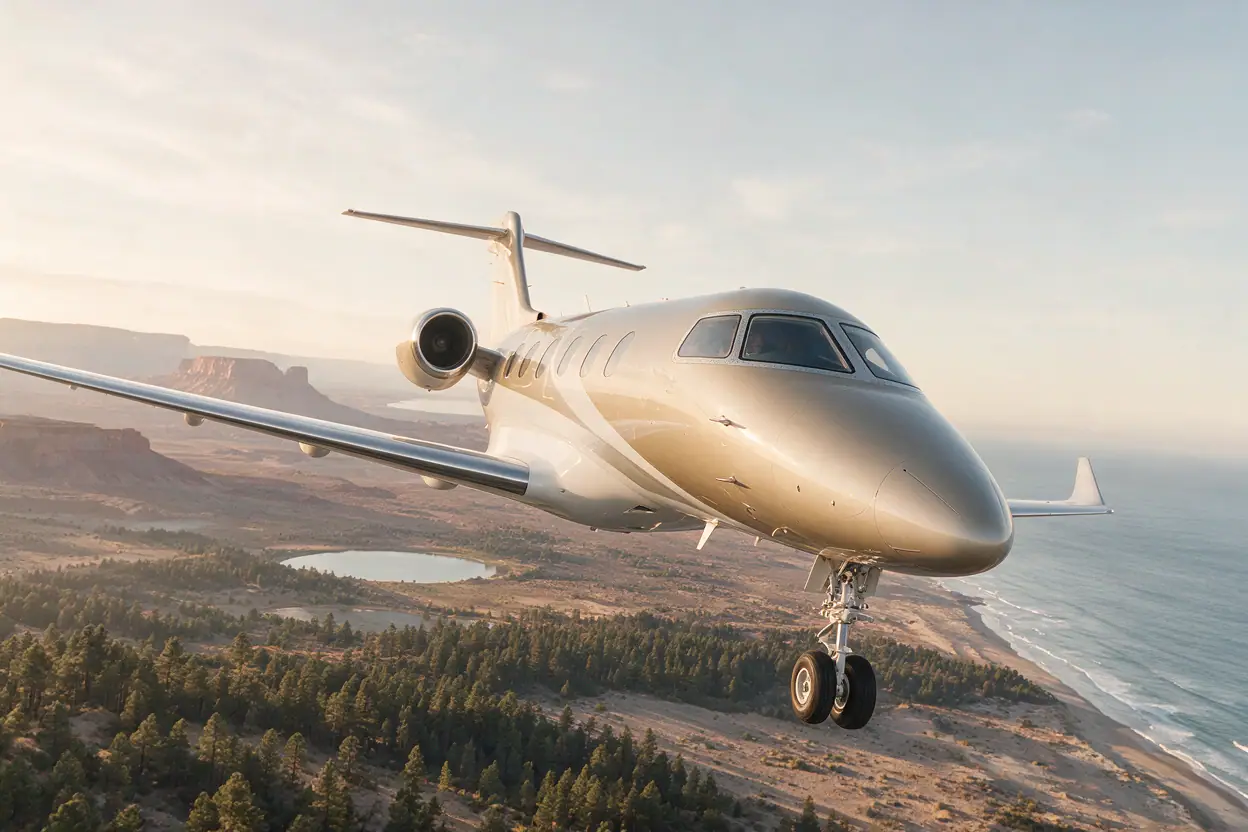
Private Charter Flight Chicago to New York
Private charter flight Chicago to New York covers 619 nautical miles nonstop. A light jet flies the leg in 1 hour 49 minutes. Expect $7,000 to $10,500 one way for that class. The bigger decision is often which New York airport you use.
- 619 nm712 sm
- 1h 49mlight jet flight time
- $7,000–$10,500one-way quote
Chicago to New York private jet costs by aircraft type
Flying private from Chicago to New York is 619 nautical miles, about 1h 49m on a light jet, quoted near $7,000–$10,500 one way.The table compares five cabin classes on the same nonstop city pair, so the figures line up directly. Times are block times in still air; eastbound winds aloft often help. Prices are broad estimates for a one-way charter, before positioning or crew fees are confirmed. Use them to see how fast cost climbs against time saved.
| Class | Flight time | One-way ballpark | Notes |
|---|---|---|---|
| Turboprop | 2h 28m | $5,500–$8,500 | No fuel stop |
| Light jet | 1h 49m | $7,000–$10,500 | Best suited |
| Midsize jet | 1h 47m | $9,000–$14,000 | No fuel stop |
| Super-midsize jet | 1h 41m | $12,000–$17,000 | No fuel stop |
| Heavy jet | 1h 41m | $16,000–$24,500 | No fuel stop |
Ballpark figures are for the whole aircraft, not per passenger, and exclude federal excise tax and segment fees. Duration covers taxi, climb and descent.
Flying Chicago to New York commercial or private
Airline figures are the cheapest fares Google Flights listed for a single traveller on Dec 9, 2026 (pulled Nov 15, 2026); the charter line is our estimate for the entire aircraft. With 7 passengers, airline first class seats come to roughly $1,883, versus $7,000–$10,500 to charter the entire light jet.
| Choice | Airline / aircraft | Hours | One-way ballpark | Seat share |
|---|---|---|---|---|
| Airline economy | Delta · nonstop | 2h 15m | $149 | $149 |
| Airline first class | Delta · nonstop | 2h 25m | $269 | $269 |
| Light jet | Entire aircraft, seats 7 | 1h 49m | $7,000–$10,500 | $1,000–$1,500 |
Airline ticket prices shift daily and do not cover bags above the fare allowance; the per-seat charter number presumes all seats are occupied.
Private charter flight Chicago
Demand peaks on Friday afternoons eastbound and Monday mornings westbound, which is the opposite of what many leisure travelers expect. If your trip aligns with those windows, then booking several days out gives you a better pick of aircraft and avoids the premium that comes with last-minute positioning. Friday eastbound is the tightest window for a private charter flight Chicago to New York, so lock the tail number early. Summer thunderstorms across Ohio and Pennsylvania can reroute flights and stretch block times; the same is true of winter de-icing at both ends. If you are flying in July or January, then build a cushion into your ground plans rather than assuming the published time holds.
If you need a same-day round trip, then a morning departure and an evening return works at under two hours each way, but you will pay for the aircraft to wait or reposition. Confirm the return slot early, especially at Teterboro. Prices are estimates and firm up once an operator confirms availability for your date.

Leaving Chicago
Chicago Executive Airport (PWK) serves the northern suburbs and is the quieter general aviation field of the two. Midway (MDW) has 6,522 feet and sits closer to the city, though you share the field with commercial traffic and TSA screening if you use the terminal. PWK's 5,001-foot runway suits light jets on most Chicago to New York departures, so confirm your aircraft type if summer heat is in play.
If you are coming from downtown, allow extra time for the drive to PWK versus MDW. In winter, de-icing at either field adds ground time before you depart.
Arriving in New York
Teterboro (TEB) has a 6,997-foot runway and is the busiest business aviation airport in the region, so slot and parking constraints can add ground delays at peak hours. Westchester (HPN) offers 6,549 feet and a calmer ramp but sits farther from Manhattan. Neither is a commercial terminal, which is the point: you clear the ramp and go. Teterboro's 6,997 feet handles any jet in this class, but peak-hour parking is tight. If your final destination is Manhattan, budget roughly 30 to 50 minutes by car from either airport depending on traffic. That road time is the real variable on this route, not the flight.
For a return leg, book your slot at Teterboro early if you are flying Friday afternoon, when the ramp fills.
| Field | ID | Rwy |
|---|---|---|
| Teterboro Airport | KTEB / TEB | 6,997 ft |
| Westchester County Airport | KHPN / HPN | 6,549 ft |
| Chicago Midway International Airport | KMDW / MDW | 6,522 ft |
| Chicago Executive Airport | KPWK / PWK | 5,001 ft |
How the light jet suits this route
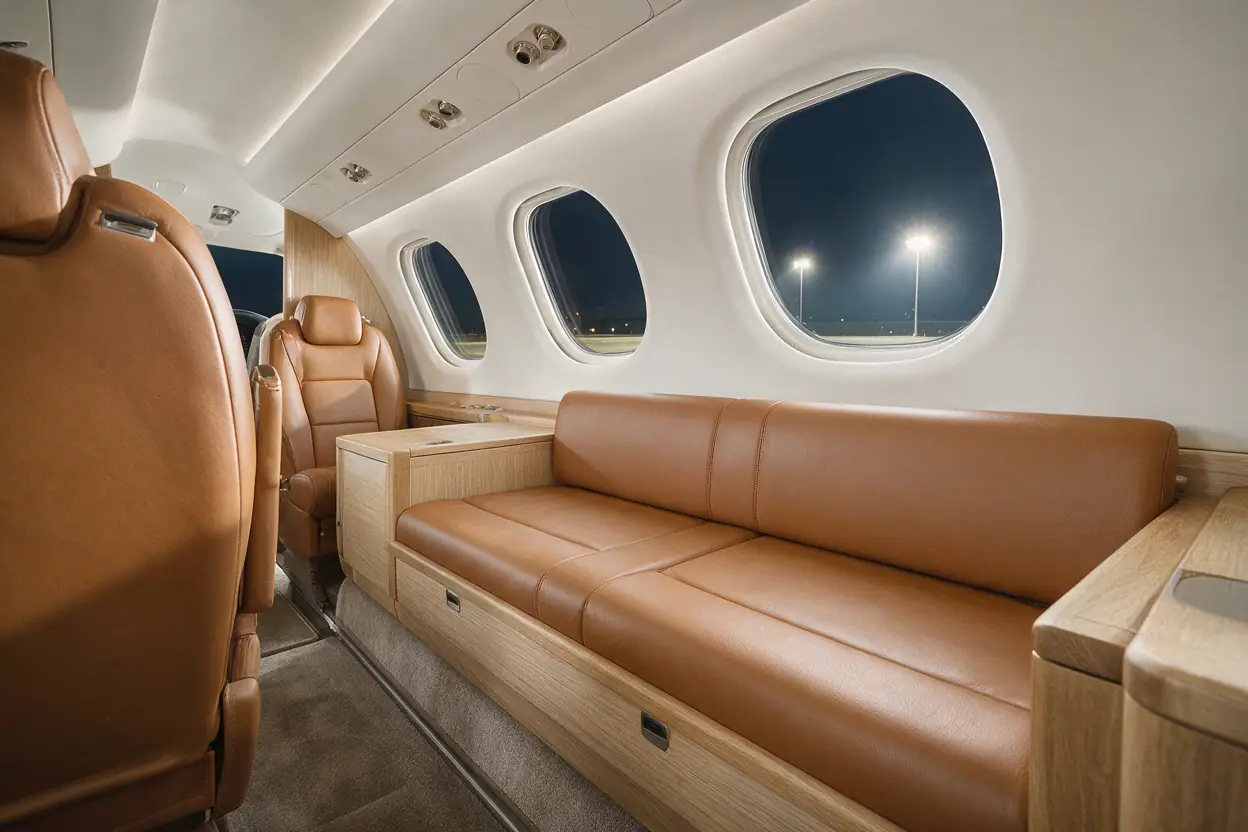
For 619 nautical miles, the light jet is the sensible default. It covers the distance nonstop with range to spare, climbs above most weather, and fits the runway lengths at both Teterboro and Westchester. A light jet does this 619-mile leg in 1 hour 49 minutes for $7,000 to $10,500. The Embraer Phenom 300E and Pilatus PC-24 are typical, seating seven or eight with real baggage space. Midsize jets run $9,000 to $14,000, against $7,000 to $10,500 for a light jet, useful if you work in flight or travel with four or more adults. Super-midsize and heavy jets trim only minutes off the block time on this distance, so the higher cost buys comfort and luggage room, not speed. For two travelers with carry-ons, the light jet is the better value.
Turboprops offer a lower entry price but stretch the trip to 2 hours 28 minutes, a real difference if you need to be in Manhattan by mid-morning. A midsize jet at $9,000 to $14,000 gives stand-up room for the 1 hour 47 minute flight. Weigh that against how much you value the cabin versus the schedule. On this short regional leg, the aircraft you pick changes the price far more than the time it saves.
Embraer Phenom 300E
- 7 seats
- 464 kt cruise
- 2,010 nm max range
Cabin of 4 ft 11 in tall, 17 ft 2 in long. Luggage 84 cu ft.
Pilatus PC-24
- 8 seats
- 440 kt cruise
- 2,000 nm max range
Cabin of 5 ft 1 in tall, 23 ft long. Luggage 90 cu ft.
Other private jet routes like Chicago–New York
The 6 private jet city pairs here span 505 to 808 nautical miles, with one-way light jet quotes running $6,000 to $13,000.
Queries on this lane
How long is a private charter flight Chicago to New York?
Block time runs about 1 hour 49 minutes in a light jet and 1 hour 41 minutes in a super-midsize or heavy jet, over 619 nautical miles. Winds aloft on the eastbound leg often help slightly. Add roughly 30 to 50 minutes of road time from Teterboro or Westchester into Manhattan when planning your day.
What does a private charter flight Chicago to New York cost?
For a light jet, expect roughly $7,000 to $10,500 one way. Midsize jets land around $9,000 to $14,000, while heavy jets run $16,000 to $24,500. These are estimates; the firm figure depends on your date, the specific aircraft, and whether the jet is already positioned in Chicago.
Which airports serve this route?
On the Chicago side, Midway (MDW) and Chicago Executive (PWK) are the usual departures. In the New York area, Teterboro (TEB) and Westchester (HPN) handle most private arrivals. Teterboro has the longer runway at 6,997 feet but the busier ramp; Westchester is calmer but farther from the city.
Can I do a same-day round trip on a private charter flight Chicago to New York?
Yes. At under two hours each way, a morning departure and evening return is comfortable, though you will pay for the aircraft to wait or reposition. Confirm the return slot early if you are flying into Teterboro, where peak-hour parking is limited. A light jet keeps the day trip economical.
What aircraft fly this route?
Light jets like the Embraer Phenom 300E and Pilatus PC-24 are the most common choice for this distance, seating seven or eight. Midsize and super-midsize jets are available if you need more cabin room. Turboprops also make the trip nonstop in about 2 hours 28 minutes at a lower price point.
Does weather affect this route?
It can. Summer thunderstorms over Ohio and Pennsylvania may force reroutes, and winter de-icing at either end adds ground time. The flight itself is short enough that a 30-minute delay is significant. Booking a few days ahead gives you flexibility to shift departure times if a front is forecast.