
Private air charter aircraft by
Private air charter aircraft split into five groups, from turboprops to heavy jets. Light jet charters run $3,800 to $5,800 per hour on our estimates. The choice comes down to range, cabin and baggage.
- Start
- Planes
Buying a seat on a scheduled airline means accepting the airline's airport, its schedule and its cabin. A private charter flight starts with your list instead. The aircraft type you pick decides how far the flight can go without a fuel stop and how much cabin you get for the money.
This page compares the main classes and the models most often quoted on US routes. Hourly figures are estimates from market ranges and move with repositioning, crew duty, fuel and the day of the week. Expect a firm quote only after an operator confirms availability for your dates and route.
How many of these jets are based in the US
The FAA registry lists 18,165 business jets and 13,001 turboprops with current US registrations; 905 jets sit in fractional ownership, and the typical jet rolled out in 2008.
| Model | Grouped under | Nationwide | Largest registry in |
|---|---|---|---|
| Daher TBM 960 | TBM 700-960 series | 987 | Delaware (117) |
| Beechcraft King Air 350i | King Air 350 series | 748 | Texas (82) |
| Embraer Phenom 300E | Phenom 300 series | 660 | Ohio (81) |
| Pilatus PC-24 | Pilatus PC-24 | 200 | New Hampshire (22) |
| Cessna Citation Latitude | Citation Latitude | 392 | Utah (12) |
| Hawker 800XP | Hawker 800 series | 353 | Delaware (81) |
| Bombardier Challenger 350 | Challenger 300/350 series | 868 | Utah (120) |
| Gulfstream G280 | Gulfstream G280 | 289 | Utah (47) |
| Gulfstream G450 | Gulfstream IV/G450 series | 610 | California (86) |
| Bombardier Challenger 650 | Challenger 600-650 series | 562 | Utah (63) |
Origin: FAA aircraft registry, active registrations only, as of Nov 2, 2026. Models are tallied by type-certificate family.
States where business jets concentrate
| State | On register |
|---|---|
| Texas | 1,671 |
| Utah | 1,578 |
| Florida | 1,569 |
| Delaware | 1,556 |
| California | 1,044 |
| Ohio | 675 |
| Tennessee | 649 |
| North Carolina | 479 |
| New York | 460 |
| Kansas | 399 |
How to compare charter aircraft
Match the aircraft to the longest leg first. A light jet with 1,400 nautical miles of range cannot fly New York to Los Angeles at 2,129 nautical miles without a fuel stop, and the tables above show a 6h 15m estimate for that route in a light jet. A super-midsize or heavy jet covers it nonstop.
Then check the airport, not just the city. Van Nuys and Teterboro sit close to Los Angeles and New York and both handle jets, while Centennial outside Denver sits at 5,885 ft. On a hot July day, density altitude there can reach about 9,200 ft, which limits some light jets. Turboprops handle these conditions better than short-range jets.
Ask what the hourly figure includes. Federal Excise Tax, segment fees, crew overnight costs and repositioning can change a quote by more than a class upgrade would. A jet charter quoted at a lower hourly rate may carry a longer repositioning leg, and that empty leg still has a price.
Finally, confirm the operator's standing. ARGUS and Wyvern ratings and IS-BAO registration give you a way to compare operators, and you can check the FAA Part 135 listing for the aircraft. A broker quote is an estimate until an operator confirms the tail number, the crew and the price.
Private air charter aircraft and Part
The FAA Part 135 Operators and Aircraft list dated Mar 25, 2026 counts 450 Pilatus PC-12 airframes and 414 Bombardier Challenger 300/350 jets among business types. That count tells you which air charter aircraft are easiest to source on short notice, because a larger pool of listed airframes means more operators competing for your dates.
| Aircraft type | Class | Listed on Part 135 certificates |
|---|---|---|
| Pilatus PC-12 | turboprop | 450 |
| Bombardier Challenger 300/350 | super-midsize jet | 414 |
| Learjet 35/45/60 | light and midsize jet | 344 |
| Beechcraft King Air 200/350 | turboprop | 333 |
| Embraer Phenom 300 | light jet | 326 |
| Cessna Citation CJ series | light jet | 299 |
| Cessna Citation Excel/XLS | midsize jet | 273 |
| Cessna Citation Latitude | midsize jet | 249 |
| Gulfstream G-V/G550/G650 family | heavy jet | 240 |
| Bombardier Global | heavy jet | 217 |
Source: FAA, Part 135 Operators and Aircraft, list dated Mar 25, 2026. Business aircraft types only.
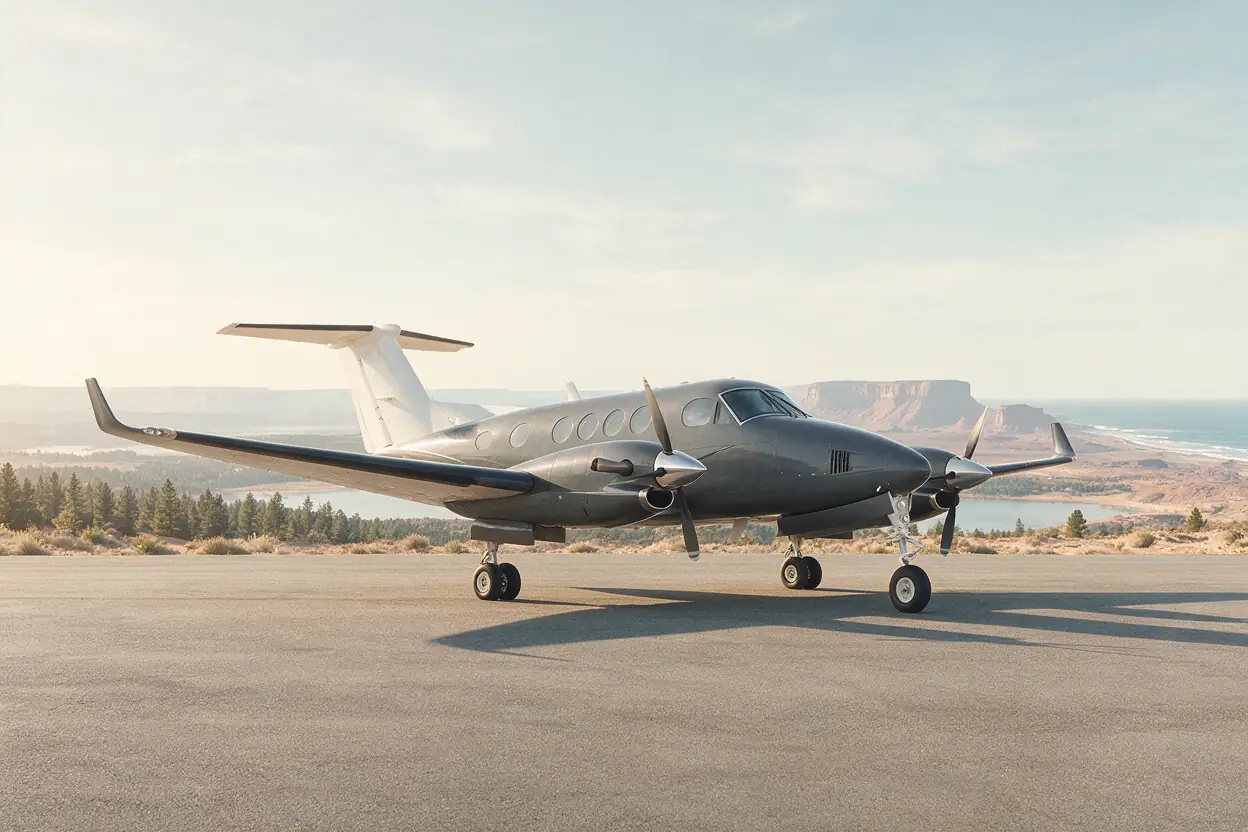
Turboprop
Turboprops burn less fuel and reach short runways that jets cannot. Rates run $2,200 to $3,500 per hour, cruise near 300 knots and carry 6 to 8 passengers about 1,500 nautical miles. For a 200-mile leg the savings are real, but a 900-mile flight takes noticeably longer than a light jet would.
Daher TBM 960
- 6 seats
- 330 kt cruise
- 1,730 nm max range
The Daher TBM 960 carries 6 passengers at 330 knots with a 1,730 nautical mile range. Its cabin is 4 ft tall and 13 ft 3 in long, with 32 cu ft of baggage. It is a single-engine turboprop, so some operators cannot fly it over water or at night under instrument rules. Ask before you assume.
Beechcraft King Air 350i
- 8 seats
- 312 kt cruise
- 1,800 nm max range
The Beechcraft King Air 350i seats 8 at 312 knots and reaches 1,800 nautical miles, with a 55 cu ft baggage hold. The cabin stands 4 ft 9 in tall and runs 16 ft 8 in long. It is a strong pick for short runways and regional airports where jets are restricted by runway length.
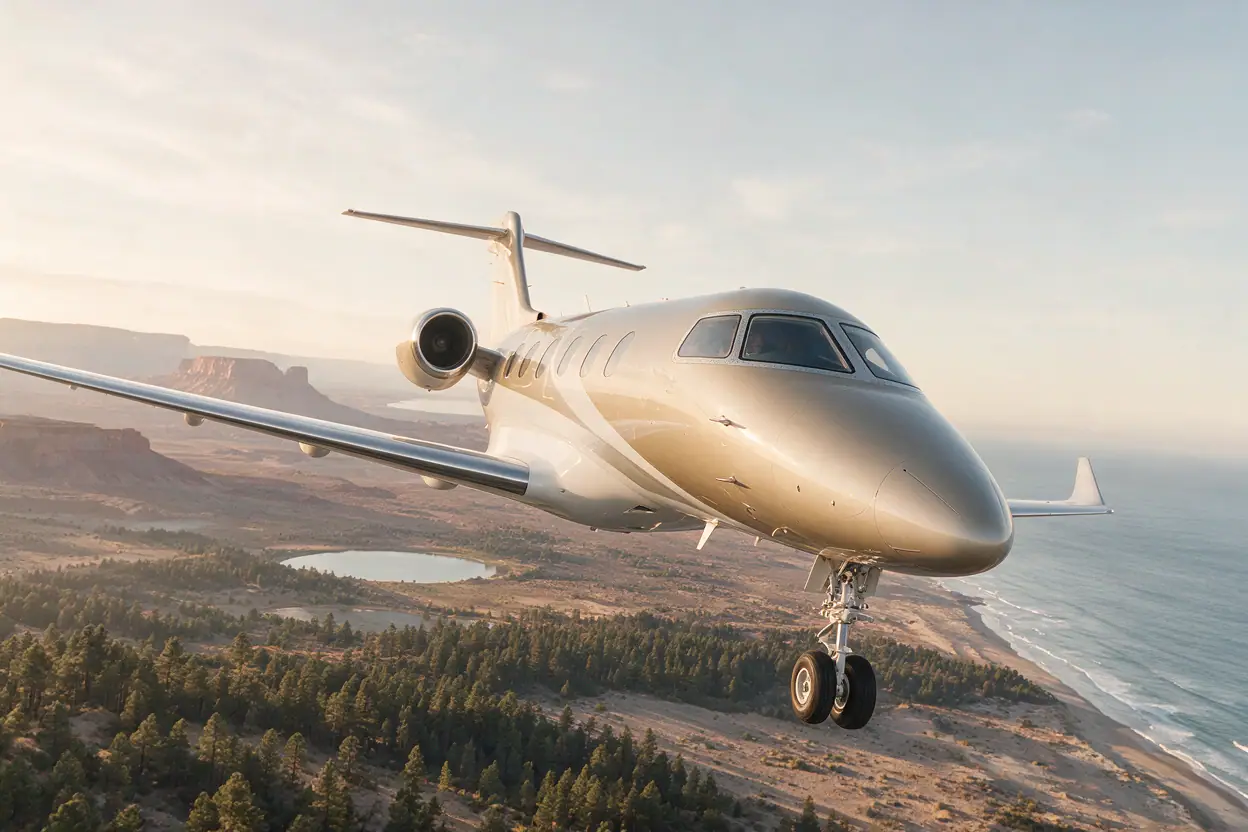
Light jet
Light jets cover most US routes under two hours and carry 4 to 7 passengers at $3,800 to $5,800 per hour. Cruise is about 430 knots with a typical range near 1,400 nautical miles. Cabins are compact, so tall passengers and long legs are better served one class up. Baggage space is the common constraint.
Embraer Phenom 300E
- 7 seats
- 464 kt cruise
- 2,010 nm max range
The Embraer Phenom 300E is a light jet carrying 7 passengers at 464 knots and 2,010 nautical miles. The cabin is 4 ft 11 in tall and 17 ft 2 in long, with 84 cu ft of baggage. Its speed makes it competitive with midsize jets on flights of two hours or less.
Pilatus PC-24
- 8 seats
- 440 kt cruise
- 2,000 nm max range
The Pilatus PC-24 seats 8 at 440 knots with a 2,000 nautical mile range and a 90 cu ft baggage hold. The cabin is 5 ft 1 in tall and 23 ft long, generous for a light jet. It can use shorter and unpaved runways than most jets in its class, which opens smaller airports.
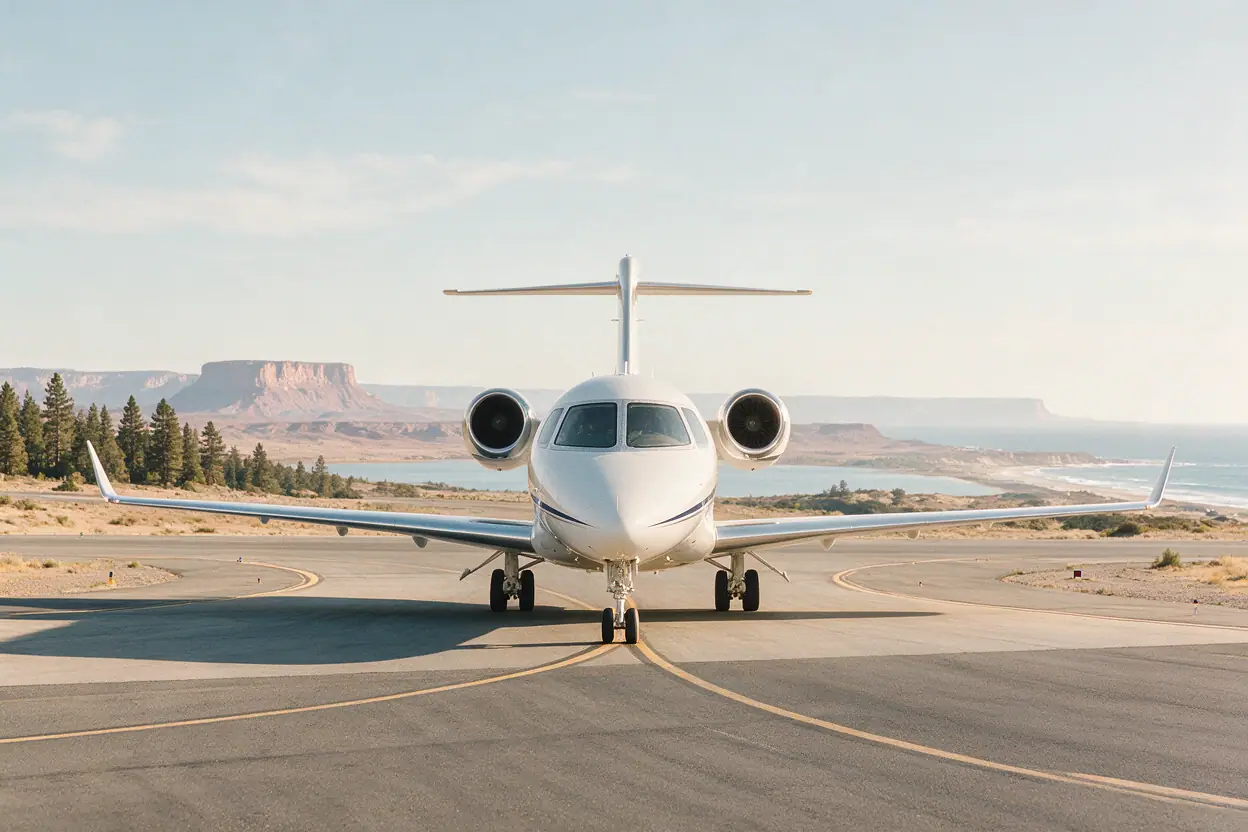
Midsize jet
Midsize jets carry 7 to 9 passengers at $5,200 to $7,800 per hour, cruise about 440 knots and reach roughly 2,100 nautical miles. The stand-up cabin and larger baggage hold make them the default for three-hour transcontinental legs. They also handle coast-to-coast routes with a fuel stop or a favorable wind.
Cessna Citation Latitude
- 9 seats
- 446 kt cruise
- 2,700 nm max range
The Cessna Citation Latitude is a midsize jet for 9 passengers, cruising 446 knots over 2,700 nautical miles. The cabin stands 6 ft tall and stretches 21 ft 9 in, with 127 cu ft of baggage. It is one of the most listed midsize types in the US, so availability on short notice is usually better.
Hawker 800XP
- 8 seats
- 447 kt cruise
- 2,540 nm max range
The Hawker 800XP carries 8 passengers at 447 knots with 2,540 nautical miles of range. The cabin is 5 ft 9 in tall and 21 ft 4 in long, but baggage is limited to 50 cu ft. Golf bags and large ski cases need checking against that figure before you book.
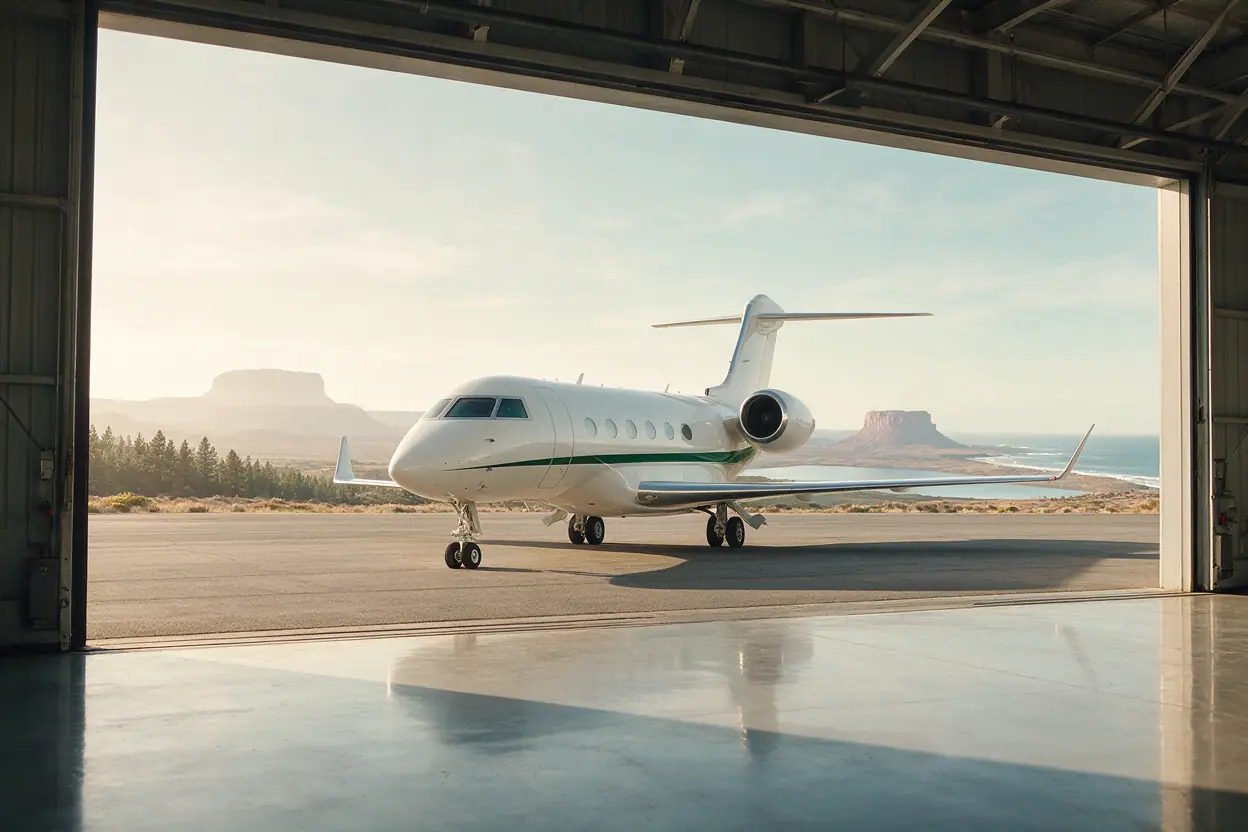
Super-midsize jet
Super-midsize jets fly 8 to 10 passengers at $7,200 to $10,000 per hour, cruise near 470 knots and cover 3,200 nautical miles. That range clears New York to Los Angeles nonstop in most conditions. Cabins are tall enough to stand and walk, which matters on flights past four hours.
Bombardier Challenger 350
- 10 seats
- 470 kt cruise
- 3,200 nm max range
The Bombardier Challenger 350 is a super-midsize jet for 10 passengers at 470 knots over 3,200 nautical miles. The cabin is 6 ft tall and 25 ft 2 in long, with 106 cu ft of baggage. It handles New York to Los Angeles nonstop and is one of the most listed super-midsize types.
Gulfstream G280
- 9 seats
- 482 kt cruise
- 3,600 nm max range
The Gulfstream G280 seats 9 at 482 knots with a 3,600 nautical mile range. The cabin is 6 ft 3 in tall and 25 ft 10 in long, and baggage totals 154 cu ft. Its range covers transatlantic legs that many super-midsize jets must split with a fuel stop.
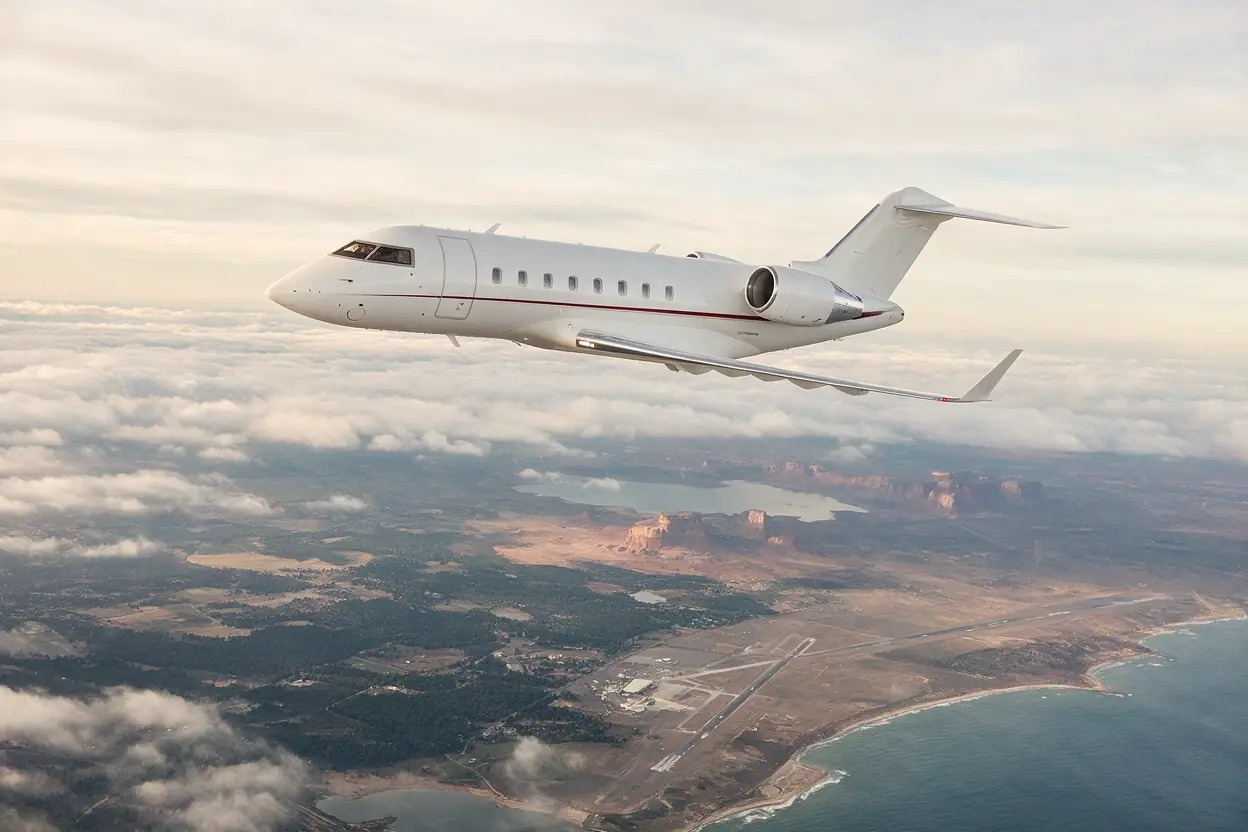
Heavy jet
Heavy jets carry 10 to 14 passengers at $9,500 to $14,500 per hour with 4,000 nautical miles of range. They suit transcontinental and Hawaii flights, and long international legs. Larger cabins and baggage holds come with higher airport fees on shorter hops, so heavy aircraft are seldom the sensible pick under two hours.
Gulfstream G450
- 14 seats
- 476 kt cruise
- 4,350 nm max range
The Gulfstream G450 is a heavy jet carrying 14 passengers at 476 knots and 4,350 nautical miles. The cabin runs 45 ft 1 in long and 6 ft 2 in tall, with 169 cu ft of baggage. It suits long international flights where a full cabin and luggage both matter.
Bombardier Challenger 650
- 12 seats
- 470 kt cruise
- 4,000 nm max range
The Bombardier Challenger 650 carries 12 passengers at 470 knots with 4,000 nautical miles of range. The cabin stands 6 ft 2 in tall and runs 28 ft 4 in long, with 115 cu ft of baggage. It is a common pick for transcontinental flights with a full passenger load.
FAQ
How much does it cost to charter a private air charter aircraft?
Light jets run $3,800 to $5,800 per hour and midsize jets $5,200 to $7,800 per hour on our estimates. A 199-nautical-mile hop from Los Angeles to Las Vegas is quoted at $4,000 to $6,000 in a light jet, and New York to Miami at $10,000 to $15,000. Taxes, fees and repositioning sit on top until an operator confirms.
How much does it cost to charter a private plane?
Light jet charters start around $3,800 per hour, midsize around $5,200 per hour on our estimates. A 902-nautical-mile New York to Palm Beach flight takes about 2h 30m and is quoted at $9,500 to $14,500. Turboprops are lower at $2,200 to $3,500 per hour for short legs.
How much is a 2 hour flight on a private jet?
At light jet rates of $3,800 to $5,800 per hour, a two-hour flight lands near $7,600 to $11,600 before tax and fees. The New York to Palm Beach route covers 902 nautical miles in about 2h 30m and is quoted at $9,500 to $14,500. A midsize jet on the same leg costs more but carries more luggage.
What is the cheapest way to fly privately?
Turboprops at $2,200 to $3,500 per hour are the lowest-cost class, and they suit short routes and small airports. On a 96-nautical-mile leg like Denver to Aspen, a light jet is quoted at $4,000 to $6,000, so the gap narrows once minimum charges apply. Cheapest is not always best if the cabin or range falls short.
When does a private air charter aircraft need a fuel stop?
When the route is longer than the aircraft's range. A light jet with 1,400 nautical miles typically needs a stop for Los Angeles to Honolulu at 2,217 nautical miles, so a super-midsize or heavy jet is the better fit. Aspen in winter and Centennial in summer add density altitude limits that reduce payload and range.
Which private air charter aircraft are easiest to source?
The Pilatus PC-12, with 450 airframes listed on Part 135 certificates as of March 25, 2026, according to the FAA, is the most widely available type. The Bombardier Challenger 300/350 follows at 414. A larger pool means more operators can quote your dates, but availability on a specific day still depends on their schedules.